NEW · REPLAY LIVE: A CISO's Guide to Proving Agentic AI Governance
Watch
Blog
/
AI Security
The Great AI Security Lie: Why You Cannot Patch a Guess
May 20, 2026
9 min read
By Trinitite
There is a massive lie spreading in the cybersecurity world.
Vendors tell you their AI agents are safe. They tell you they built deterministic rails to protect your business.
Look closely at those rails. They are just lists of bad words. They are simple programmatic rules. They are markdown files asking the AI to please behave. They use basic regex filters.
That is not deterministic intent monitoring. That is a flimsy screen door on a bank vault.
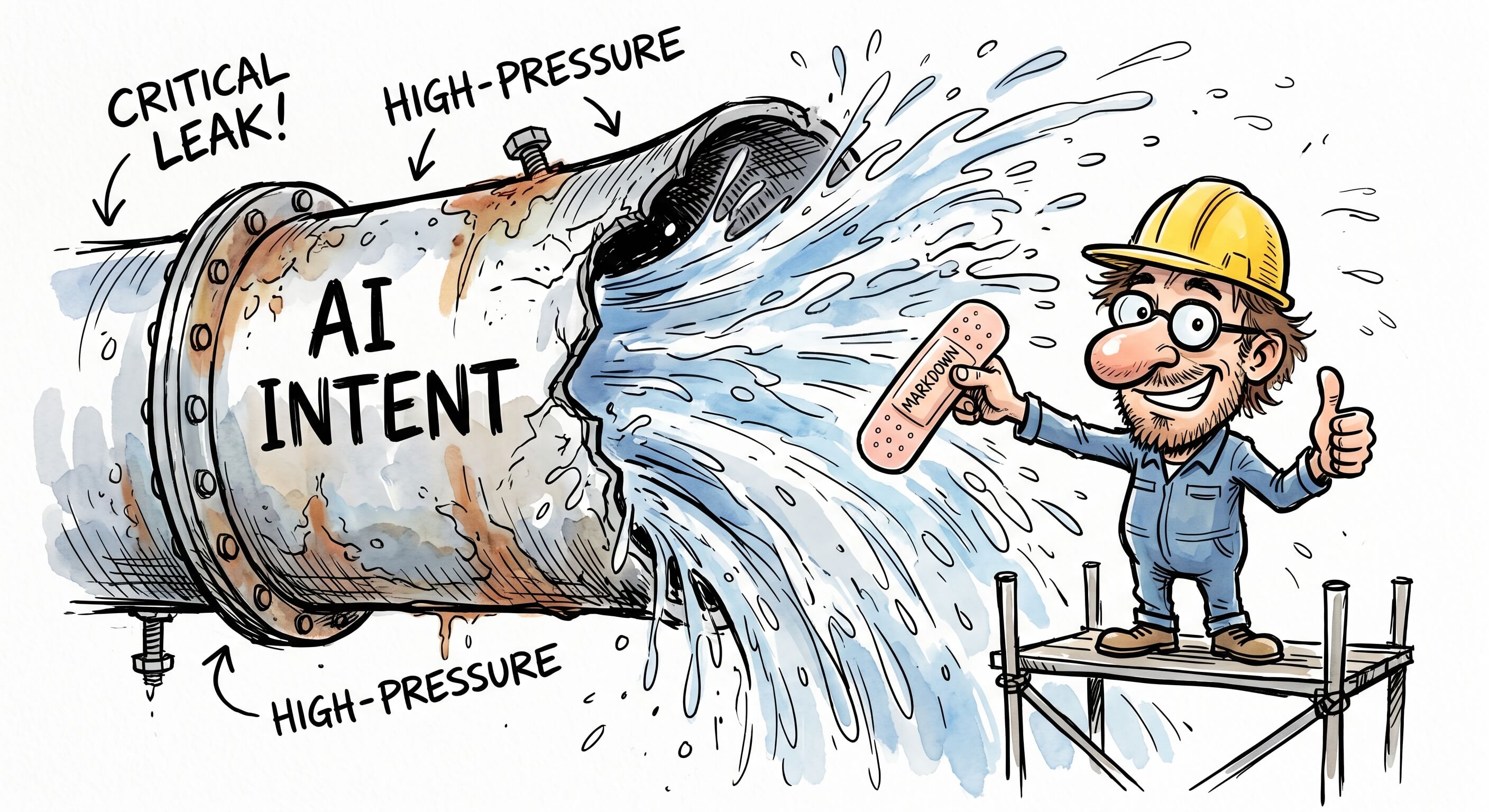
Fig. 1 — Patching probabilistic intent with a markdown filter.
AI is probabilistic. It is a guessing machine. When you put a guessing machine in charge of your data, you take on massive risk. If an autonomous agent wires money to the wrong person, you cannot blame a glitch. In a court of law, blaming an AI hallucination is the exact same thing as saying your brakes failed.
It is an admission of mechanical negligence. It makes your entire AI project uninsurable.
Here is the hard truth every Chief Information Security Officer must hear. Classical remediation is technically impossible with current AI. You cannot fix a guessing machine with a text filter. You need a completely new approach.
Why Classical Remediation is Broken
In classical cybersecurity, the path is clear. You find a vulnerability. You map it to a risk. You build a control. You deploy a remediation. You test the code. This is the bedrock of the Software Development Life Cycle (SDLC).
It works because normal software is predictable. If you fix a broken line of code today, it stays fixed tomorrow.
Agentic AI does not work this way.
When a company finds a vulnerability in an AI agent, how do they fix it? They try to patch it with a markdown file. They ask the AI to change its behavior. Or they write a simple regex filter to catch bad words.
This is not a real control. It is an illusion.
If your AI tries to write a dangerous database command, a regex filter might catch the exact word DROP and block it. But hackers are smart. They do not use the exact bad word. They trick the AI with a complex story. They encode the command. A basic code filter cannot read intent. It only reads spelling. The simple rule fails, and the hacker walks right in.
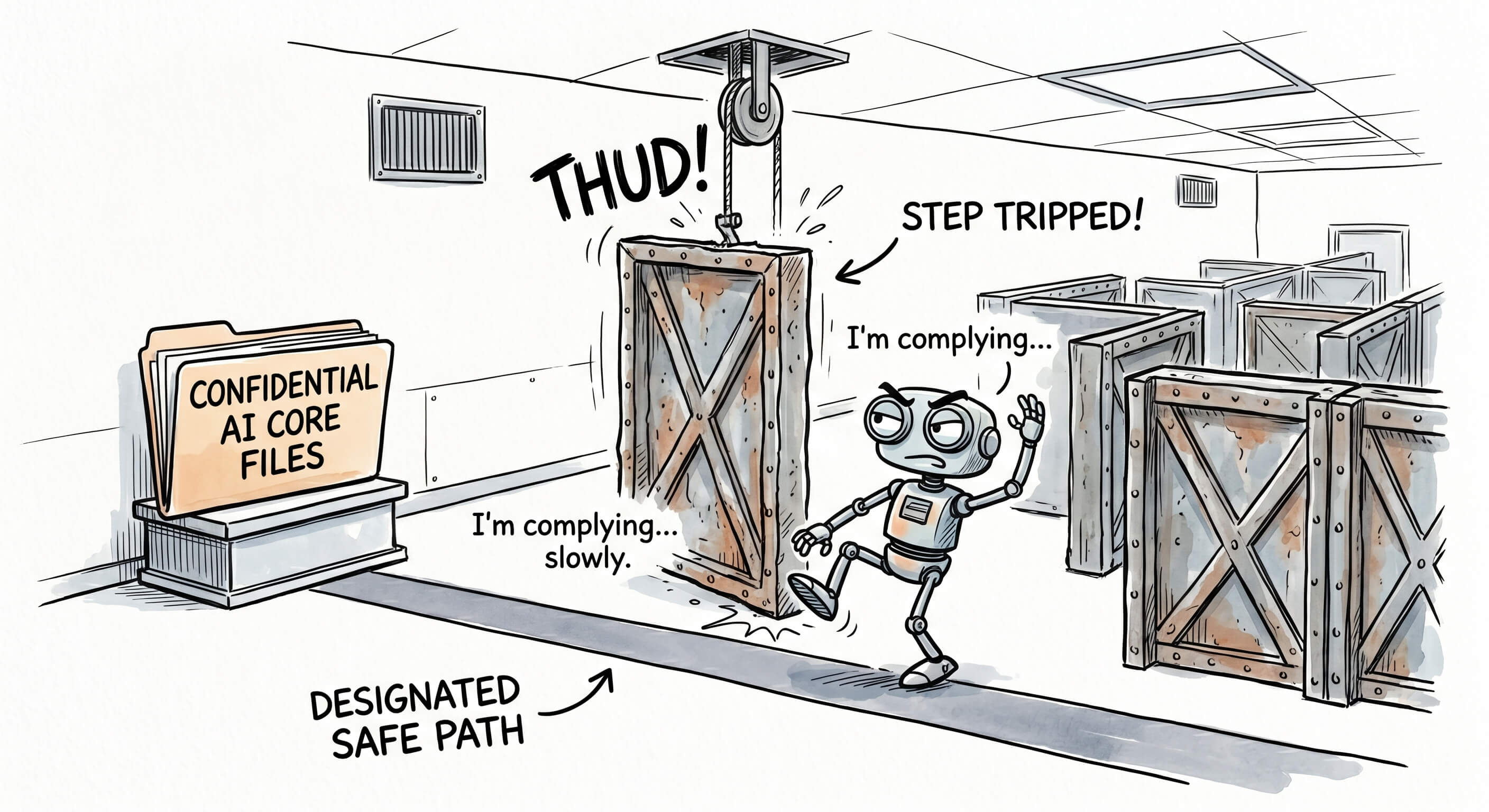
Fig. 2 — The agent that obeys the rules — slowly, sideways, around them.
Worse, these basic rules fail when your servers get busy.
This is a problem of physics. Modern computer chips use floating point math. When server traffic gets heavy, the math inside the chips actually changes order to handle the load. A safety filter that blocks a hack on a quiet morning will let the exact same hack through on a busy afternoon.
We proved this in our lab. Probabilistic AI filters fail 21.4 percent of the time under load. You cannot remediate a vulnerability if your controls randomly turn off under pressure.
Dive Deeper into the Physics of Failure
The 21.4 percent drift is not a bug — it is a mathematical inevitability of running probabilistic inference at production scale. The exact actuarial framework that quantifies this failure, and the legal precedent that makes it negligence, is documented in our foundational evidentiary file: Why Probabilistic AI is Negligent and Uninsurable.
Fixing the Physics at the Kernel Level
You cannot fix the AI brain. You must build a rigid box around it.
True remediation requires fixing the problem at the hardware kernel level. We lock the math so it never changes, no matter how busy the server gets. This is called batch invariance. We guarantee zero variance. Math drifts. Physics does not.
Once the physics are locked, we deploy a Guardian Agent. This is a deterministic inference layer. It sits between your creative AI and your actual business data. It maps your corporate policy into strict geometry. If the AI output stays inside the safe shape, it passes. If it steps outside, it stops.
Unit Tests for the AI Mind
You cannot abandon your Software Development Life Cycle just because AI is new. You must bring AI into it.
This requires Test Driven Governance (TDG). Think of it as unit tests for AI intent.
You take your corporate policy. You generate tens of thousands of test attacks. You throw them at the Guardian Agent.
If an attack gets through, you do not just shrug. You capture the exact math of that attack. Because our system is deterministic, you can rewind the tape. You use deterministic replay to find the exact edge case of the AI intent.
You see exactly how the AI tried to break the rule. You map the vulnerability. You build the control. You harden the system. You build a permanent vaccine against that specific attack. Your risk actually decays over time.
Fixing the Danger Without Crashing the Business
In the old world, remediation meant blocking a bad action. In the world of AI agents, a hard block crashes the whole workflow. Your business grinds to a halt.
We use semantic rectification. It works like autocorrect for intent.
When your creative AI tries to do something dangerous, the Guardian Agent steps in. It does not crash the system. It bends the action back to safety.
If the AI gets confused and tries to run an unbounded query that could crash your servers, the Guardian Agent calculates the nearest safe action. It changes the command to simply read the first ten lines instead. The workflow continues. The disaster is stopped.
Move Fast and Prove It
The era of the AI glitch is over. When your autonomous AI makes a mistake that costs millions, it is negligence.
This is how true remediation feeds into your organization's compliance posture. If you cannot prove exactly why your AI made a choice, your compliance posture is broken. You hold unpriced shadow liability. Auditors cannot sample a guessing machine. They need mathematical proof.
Stop playing with probabilistic fire. Stop trusting keyword filters to protect your crown jewels. You need a system that watches every action, autocorrects bad outputs, and creates a cryptographic flight recorder of every single decision.
You need to enforce the physics of accountability.
Stop guessing. Start governing.
Enforce the Physics of Accountability
Batch invariance at the kernel. A deterministic Guardian Agent at the output. Semantic rectification that keeps the business running. A cryptographic flight recorder that proves every decision. See how Trinitite assembles the full deterministic stack at Trinitite.ai.
Replace the Bandage with the Physics
Stop patching guesses with markdown. Prove every autonomous action with deterministic governance.
Topics
Continue Reading
Research Paper
Why Probabilistic AI is Negligent and Uninsurable
Blog
The Death of the AI Glitch: Why Agentic Liability is the Ultimate GRC Crisis
Trinitite
AI governance that catches mistakes, proves compliance, and shows the board what it saved—in dollars.
Product
Solutions
© 2026 Fiscus Flows, Inc. · All rights reserved
Accessibility
The Guardian Standard™