NEW · REPLAY LIVE: A CISO's Guide to Proving Agentic AI Governance
Watch
Blog
/
AI Insurance
The Telematics of Cognition: Pricing the Uninsurable AI Agent
February 26, 2026
11 min read
By Trinitite
For the past three years, the global cyber insurance market has faced a paralyzing paradox. Enterprise boards are demanding the rapid adoption of autonomous artificial intelligence to stay competitive. Simultaneously, commercial underwriters are quietly drafting blanket exclusions to strip AI liability from general corporate policies.
When actuaries cannot model a risk, they price for the apocalypse.
Because traditional generative AI operates as a probabilistic black box, insurers cannot accurately predict its failure rate. They are terrified of systemic accumulation, fearing that a single successful prompt injection attack could instantly compromise ten thousand policyholders at once.
To stabilize this market, the enterprise must abandon the illusion of static compliance. We must introduce a dynamic financial instrument capable of measuring cognitive risk in real time.
We are entering the era of cognitive telematics. By transitioning from qualitative attestations to strict quantitative measurement, organizations can finally provide insurers with the ground floor truth required to accurately underwrite the autonomous enterprise.
The Illusion of Static Attestation
Historically, risk managers and auditors have relied on frameworks like SOC 2 or ISO 27001 to prove that a corporate environment is secure. These attestations are built on the concept of statistical sampling and annual reviews.
In the agentic era, static sampling is mathematically negligent.
Autonomous agents execute thousands of distinct reasoning steps per minute. They interact with live databases, parse complex contracts, and route financial transactions at machine speed. A compliance snapshot taken six months ago offers absolutely zero guarantee that a probabilistic model will not drift into unsafe territory this afternoon under heavy server load.
Relying on a SOC 2 report to underwrite an AI agent is like insuring a commercial truck driver simply because they passed a written exam a decade ago. The insurer has no visibility into how the driver behaves on an icy road.
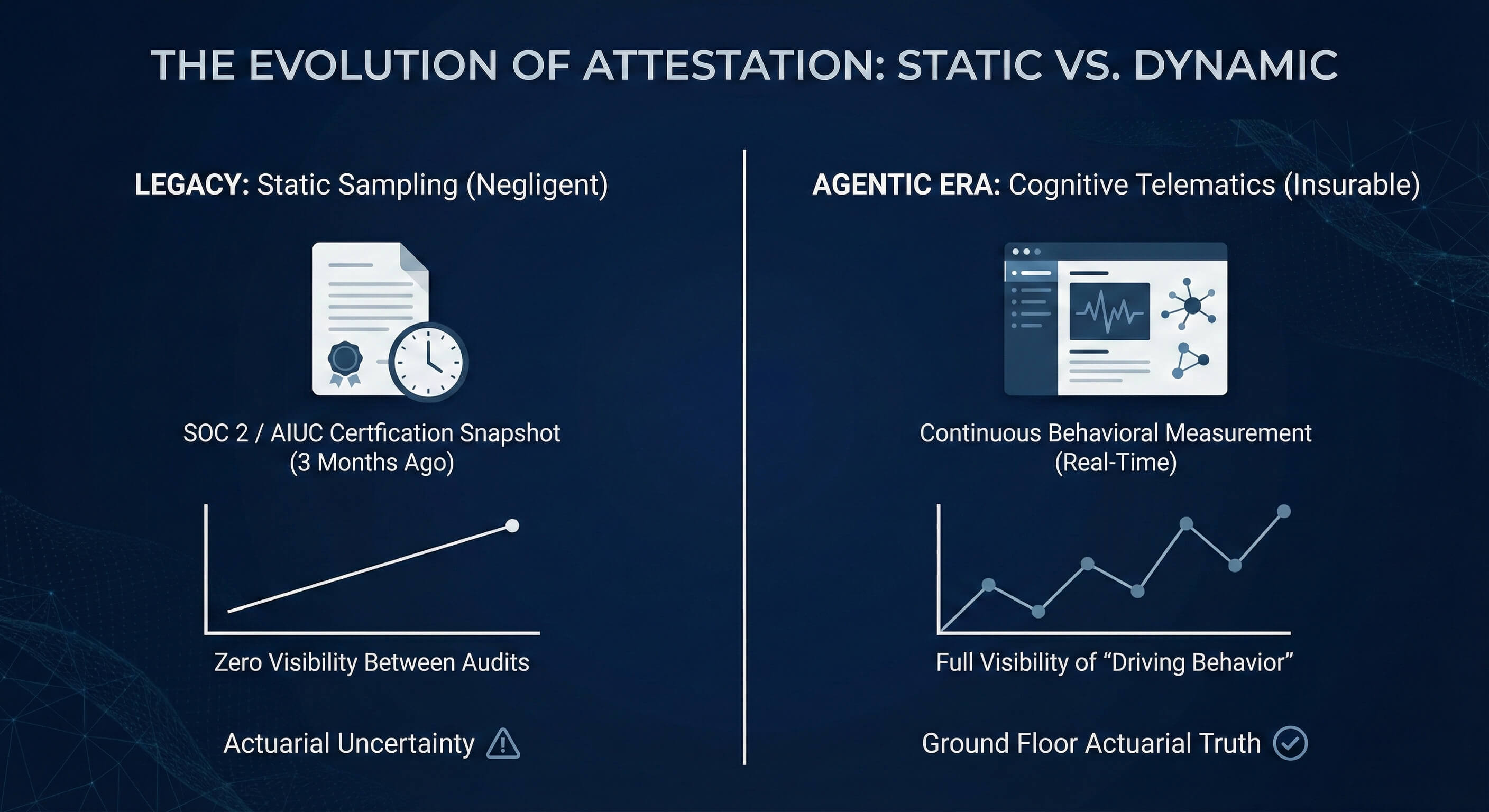
Fig. 1 — Static Attestation vs. Continuous Governance: Point-in-time compliance is inadequate for autonomous agents.
If a Chief Financial Officer signs a Sarbanes-Oxley attestation relying on an ungoverned, probabilistic financial bot, they are essentially attesting to a random number generator. To regain the trust of the reinsurance market, we must measure the actual driving behavior of the algorithm.
Intervention Density: The New Metric of Risk
The automotive insurance industry solved the visibility crisis by introducing telematics. By plugging a diagnostic device directly into a vehicle, insurers could finally track hard braking, rapid acceleration, and actual mileage. Safe drivers received lower premiums. Reckless drivers paid for their volatility.
Trinitite brings this exact telematics model to cognitive labor.
We achieve this by decoupling the creative AI model from a deterministic, mathematical Governor. Sitting strictly at the output layer, this Governor physically intercepts every proposed action the AI attempts to take. It maps these actions against your rigid corporate policies.
This architecture allows us to track a vital new actuarial metric known as Intervention Density.
In traditional IT security, a blocked attack is just a deleted log. In the Trinitite architecture, every time the Governor successfully blocks an AI hallucination or autocorrects a toxic output, it records the event in an immutable cryptographic ledger.
Intervention Density measures the exact ratio of near misses. It tells the Chief Risk Officer exactly how many times the safety brakes were applied per thousand transactions.
For the first time in history, insurers do not have to wait for a catastrophic claim to understand a client's risk profile. They possess a leading indicator. If an enterprise shows a high intervention density, the insurer knows the agent is highly volatile but successfully contained. They can offer variable rate premiums based on proven physical control rather than relying on marketing promises from model providers.
The Actuarial Foundation for Cognitive Telematics
Intervention Density only works as an actuarial metric because the Governor operates deterministically — producing identical outputs for identical inputs regardless of server load. To understand why probabilistic guardrails are physically incapable of producing this reliability, read our foundational evidentiary file: Why Probabilistic AI is Negligent and Uninsurable: Defining the New Standard of Care for the Autonomous Enterprise.
The CFO's Asset: The Net Insurable Token
The most profound impact of cognitive telematics lands directly on the corporate balance sheet.
Currently, every piece of data generated by a standard AI model is a Gross Token. A Gross Token carries a payload of helpful information combined with a hidden payload of unpriced liability. Because the enterprise cannot definitively prove that the AI did not hallucinate a subtle error, the CFO must theoretically hold massive internal capital reserves to cover potential future lawsuits. In insurance accounting, this is known as Incurred But Not Reported reserve capital.
Shadow liability freezes working capital.
Deterministic governance transforms this dynamic by minting the Net Insurable Token. When an AI output successfully passes through the Governor and is cryptographically stamped in the ledger, it is stripped of its liability. It is mathematically verified to comply with your business constraints.
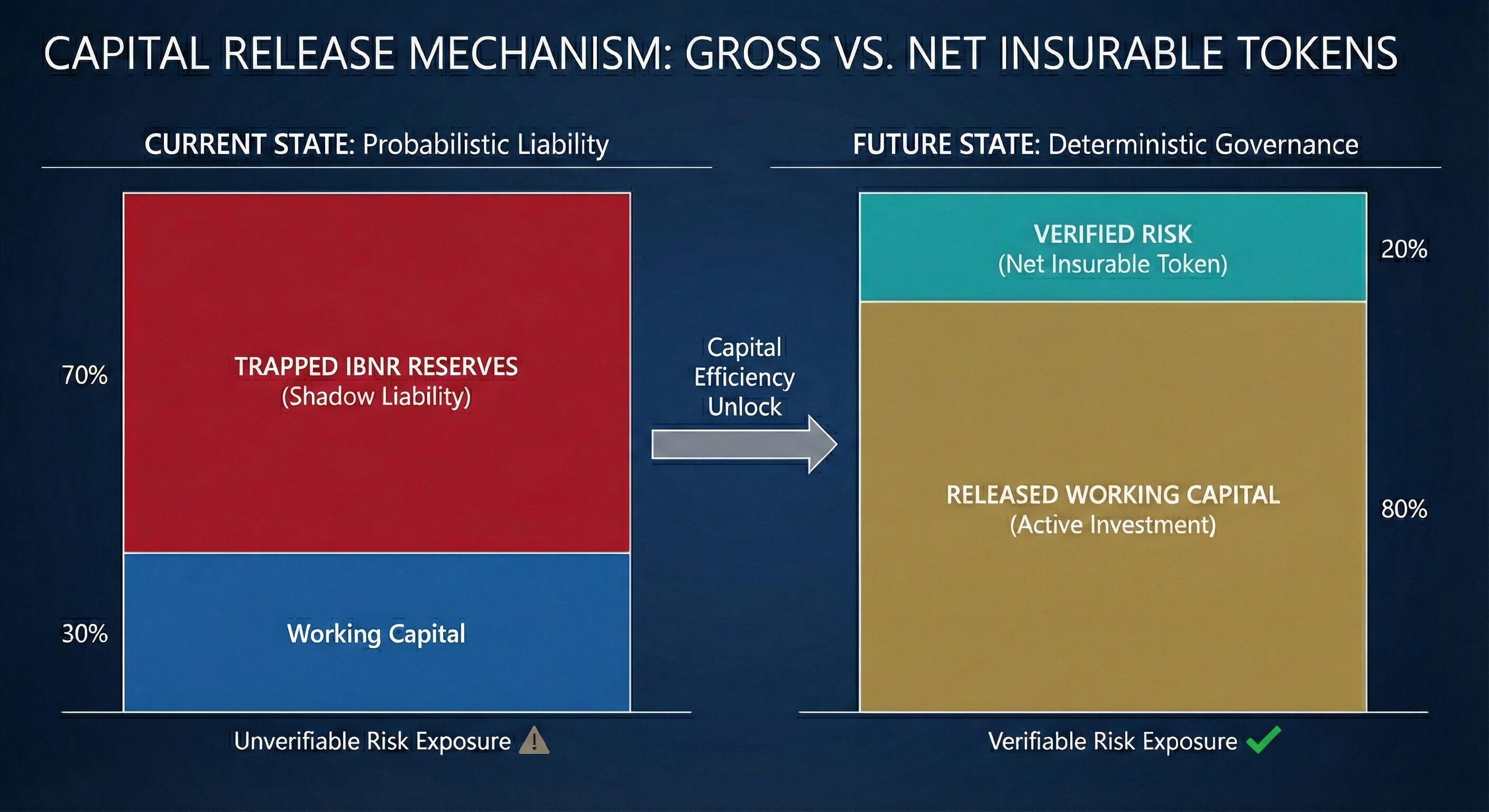
Fig. 2 — IBNR vs. Released Funds: Net Insurable Tokens convert frozen liability reserves into active capital.
For the CFO, the Net Insurable Token is not a cost center. It is a capital release mechanism. By proving to your captive insurance board or your commercial carrier that you have architecturally amputated the tail risk of your AI fleet, you can safely release those trapped capital reserves back into the business for active investment.
Reopening the Market Through Subrogation and Correlation Breaking
Ultimately, the telematics of cognition repairs the broken relationship between the enterprise and the insurance carrier.
For the Reinsurer, the adoption of deterministic cognitive telematics resolves the crisis of systemic accumulation. The greatest fear of the reinsurance market is a single exploit that simultaneously bankrupts ten thousand policyholders using the same foundational AI model. The Trinitite architecture breaks this correlation. Because every enterprise runs a mathematically distinct, customized policy manifold inside their Governor, a threat vector that bypasses one company will not mathematically bypass the others.
Furthermore, the Trinitite Glass Box ledger provides the ultimate liability offset. When a failure occurs in a standard AI deployment, the model vendor hides behind the black box defense claiming the error was an unforeseeable glitch. The enterprise is left holding the bag, and the insurer pays the massive settlement with no path to recover their losses.
Because the Trinitite system records the exact input vector, the active policy rule, and the model's precise intent, it creates an indisputable chain of custody.
If an agent fails despite strict adherence to the defined policy manifold, the ledger provides the exact smoking gun required to prove a vendor product defect. This restores the power of subrogation. Insurers can finally shift the ultimate financial loss away from their own balance sheets and onto the technology providers who built the faulty reasoning engine.
With subrogation restored and risk physically bounded, underwriters can confidently reenter the market. They can offer affirmative coverage for autonomous operations, rewarding governed enterprises with highly favorable rates while pricing reckless competitors out of the ecosystem.
Industrial machinery requires industrial measurement. It is time to stop guessing your exposure and start pricing your immunity.
Trinitite delivers industrial-grade AI governance. Move fast. Prove it.
Capitalize Your AI Governance
Transform your unpriced AI liability into a mathematically verified, insurable asset.
Topics
Continue Reading
Blog
The Psychopathy of Helpful AI
Blog
The Death of the AI Glitch
Trinitite
AI governance that catches mistakes, proves compliance, and shows the board what it saved—in dollars.
Product
Solutions
© 2026 Fiscus Flows, Inc. · All rights reserved
Accessibility
The Guardian Standard™