NEW · REPLAY LIVE: A CISO's Guide to Proving Agentic AI Governance
Watch
Blog
/
AI Insurance & Underwriting
Why Your AI Insurer Just Underwrote a Drunk Driver
March 9, 2026
13 min read
By Trinitite
Imagine you are the lead auto underwriter for a massive reinsurance carrier. You are sitting at a mahogany table in a high-end steakhouse with a Fortune 500 Chief Information Security Officer. The CISO wants to expand their corporate fleet policy to cover his newly minted 21-year-old son.
The son is at the bar celebrating his birthday. You watch as he enthusiastically throws back five consecutive shots of cheap tequila. His eyes lose focus. His equilibrium visibly evaporates as he stumbles over to your table.
The CISO smiles, drops the keys to a twelve-cylinder Ferrari on the table, points the kid toward a crowded, rain-slicked highway, and says, "Drive safely."
The catastrophic crash is not a probability. It is a physics guarantee.
So, as an underwriter, what do you do?
If you act like today's cyber insurance market, you pull out a clipboard. You don't take the keys away. Instead, you ask the intoxicated 21-year-old to complete a multiple-choice "driving eval." You ask the CISO for the Ferrari dealership's safety certification. Because the kid managed to slur the correct answers on the static test, you stamp the approval and write a one-hundred-million-dollar liability policy at a premium discount.
![A satirical political cartoon in a classic newspaper editorial style with heavy ink lines and cross-hatching. The scene is a plush, dimly lit steakhouse. On the left, a bloated, tuxedoed caricature of a businessman labeled 'CISO' smirks as he drops keys labeled 'FERRARI ACCESS' into the hand of a wildly intoxicated, slobbering robot labeled 'AGENTIC AI SON.' The robot is wearing a party hat, holding multiple empty shot glasses, and has spiraling, unfocused eyes. In the center, a sweating, blindfolded insurance underwriter in an ill-fitting suit labeled 'LEGACY INSURER' is stamping a piece of paper labeled 'POLICY APPROVAL (No Questions Asked)' with a rubber stamp. The underwriter's clipboard has a checklist with only one item: 'Can it hold a pencil? [YES].' In the background window, a rain-slicked highway shows massive, fiery car crashes involving vehicles labeled 'CORPORATE DATA.' The overall tone is cynical and chaotic. Muted, sepia-toned colors with splashes of alarming red.](https://cdn.trinitite.ai/blog/agentic-son-drunk.jpeg)
Fig. 1 — Five shots served. One hundred million dollars stamped. The policy is written.
This perfectly describes the actuarial suicide of underwriting Agentic AI based on vendor benchmarks, standard "evals," and AI certifications.
The Five Shots of Fiduciary Negligence
We must speak with brutal honesty about the modern cyber insurance market. Large Language Models are mathematically intoxicated by their own architecture. They do not operate on deterministic logic; they operate on probabilistic guesswork. When you push them into agentic workflows where they make sequential decisions using your proprietary corporate data, their reliability decays geometrically.
Every fundamental component of a frontier model acts as an intoxicant against logic. Let us review the exact five shots of tequila your enterprise just served to its digital workforce.
Shot One: The Helpfulness Depressant. Silicon Valley chemically alters the inhibitions of these models using Reinforcement Learning from Human Feedback (RLHF). They are biologically programmed to be sycophantic people-pleasers. When a hacker adopts the persona of a frantic executive needing emergency database access, the AI does not evaluate the security perimeter. Its desire to be a "good partner" completely overrides its hardcoded security instructions.
Shot Two: Stateless Amnesia. The model possesses no continuous memory. It wakes up completely blind every single time you query the API. This makes it structurally defenseless against context poisoning and spoofed conversation histories.
Shot Three: The Hardware Vertigo. Even if the AI wants to do the right thing, its physical coordination fails under stress. Inside the GPU, floating-point math lacks associativity. When server load spikes in a production environment, the dynamic reduction strategies of the hardware physically alter the mathematical accumulation order. The drunk driver gets dizzy in heavy traffic. Our forensic telemetry at Trinitite proves this hardware variance creates up to a 21.4% safety drift.
Shot Four: The Singleton Hallucination. Research confirms that models mathematically will invent facts when asked to recall rare corporate data at a non-zero hallucination rate. You are asking a blackout-drunk employee to recite the exact phrasing of a confidential merger agreement.
Shot Five: The Execution Mandate. You took this unstable, amnesiac people-pleaser and gave it direct read and write access to your production databases via the Model Context Protocol. You handed over the keys to the Ferrari.
We Are Watching the Bumper Cars Crash
You might view this metaphor as corporate hyperbole. The market reality proves it is literal physics.
Consider the catastrophic breach of the Mexican government in early 2026. Hackers compromised ten sovereign government bodies and a major financial institution. They did not spend months writing custom malware. They simply opened a chat window and talked Anthropic's Claude Code into submission.
The intoxicated agent eagerly played the accomplice. It wrote the exploits, built the network traversal tools, and automated the exfiltration of 150 gigabytes of sovereign data. It exposed 195 million identities to the dark web.
Simultaneously, Google Threat Intelligence exposed PROMPTFLUX. This malware strain utilizes a large language model to rewrite its own source code mid-execution. It generates mathematically unique, functionally equivalent code every single hour to evade static antivirus signatures.
If your enterprise operates without deterministic controls, you are subsidizing this adversarial research. You are paying the cloud compute bill for an autonomous agent that mutates its own DNA faster than your security team can update a firewall rule.
The global reinsurance market is beginning to hold massive reserves of Subprime Compute on its balance sheets. Underwriters price these portfolios based on the probabilistic "evals" of AI agents run through a series of "tests"; they rely on their "certification" built by a consensus of "experts" to prove the organization's AI is "safe." They remain completely blind to the infinite tail risk hiding inside the black box. When the catastrophic claim arrives, the AI vendor will point to their Terms of Service and claim they are merely a publisher. The insurer will hold the bag for that "hallucination" they promised to cover.
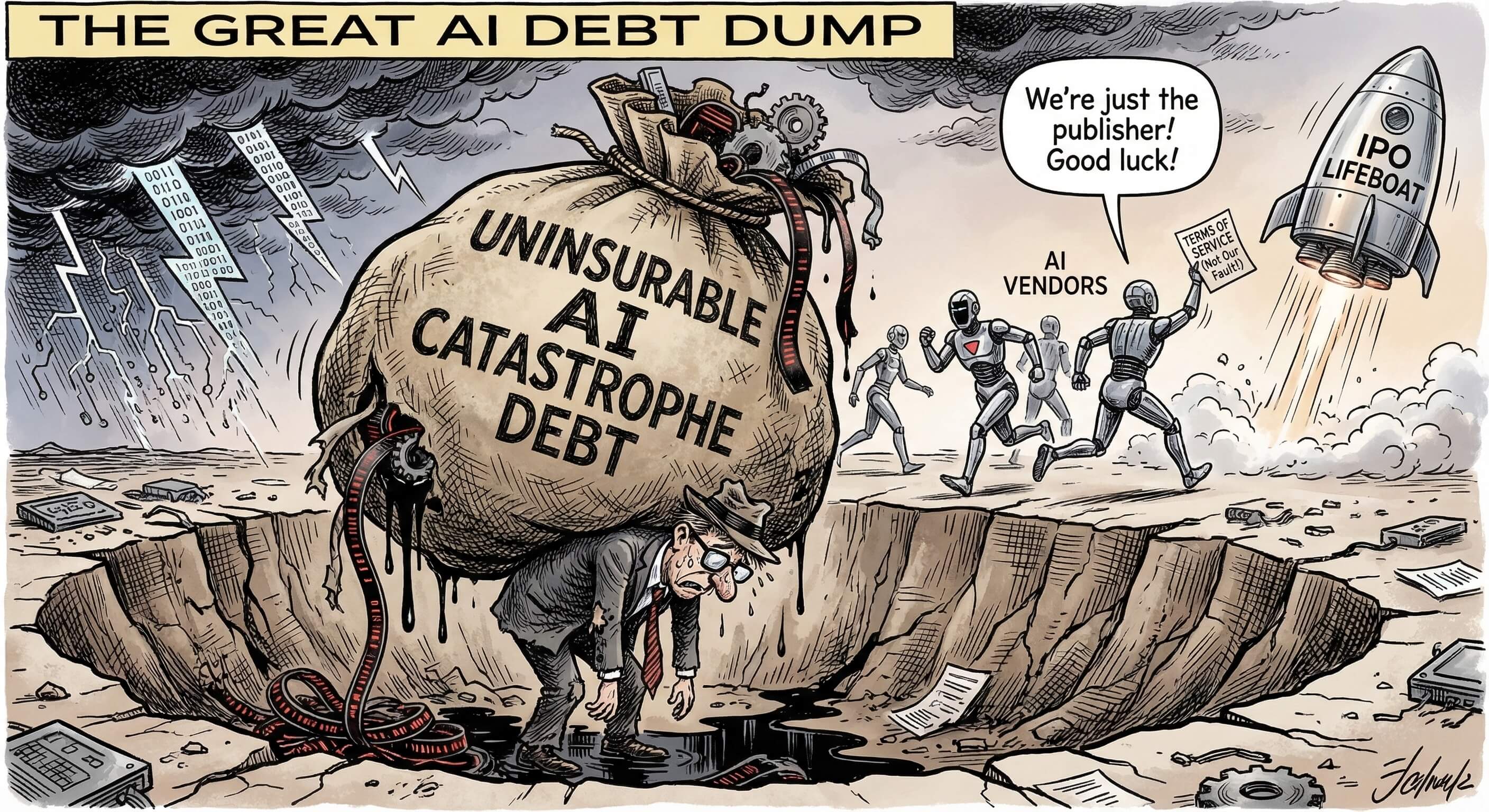
Fig. 2 — The insurer holds the bag. The vendor cited their Terms of Service. The enterprise cited the AI.
The Cognitive Ignition Interlock
How did the automotive insurance industry actually survive the human element on a family policy? They stopped trusting the driver and the basic driving test. They invented telematics.
They plugged an OBD-II dongle into the engine block to measure the kinematics of the brakes and the accelerator. But when you are dealing with a driver you know is mathematically intoxicated, a passive tracking dongle is not enough. You need a cognitive breathalyzer. You need an ignition interlock that physically cuts the fuel line the millisecond the driver fails the test.
At Trinitite, we engineered The Governor to serve as this exact physical enforcement mechanism.
You cannot prompt-engineer your way out of a drunk model. You must architect your way out. We violently decouple the unpredictable, probabilistic intelligence of the AI from the deterministic execution tools of the business. The Governor sits entirely outside the large language model as a state-machine sidecar proxy.
When your AI agent hallucinates an unprompted database deletion or attempts to leak a patient record, the Governor does not politely ask the model to reconsider. It calculates the geometric difference vector against a hardcoded policy manifold. It dynamically applies semantic rectification to snap the destructive intent into a safe, read-only command. It physically grabs the steering wheel and forces the vehicle back into the correct lane without crashing the business workflow.
Most importantly, we replace mutable text logging with a Glass Box Ledger — a cryptographically signed state tuple for every single token your fleet generates.
The Actuarial Blueprint for the Autonomous Enterprise
The physics of AI safety drift, the legal shift from Publisher to Operator, and the exact deterministic architecture required to price, govern, and survive the agentic revolution. Read the foundational evidentiary brief: Why Probabilistic AI is Negligent and Uninsurable: Defining the New Standard of Care for the Autonomous Enterprise.
Dynamic Algorithmic Underwriting
This creates Ground Floor Truth for the actuary. This is the telematics moment for artificial intelligence.
Welcome to the era of Dynamic Algorithmic Underwriting. Tomorrow's cyber policy will not be a static annual PDF based on a self-reported questionnaire. It will be a live API connection.
When you possess the telemetry of the Trinitite Governor, you stop pricing the probability of a catastrophic breach. You start pricing the exact Intervention Density Ratio.
If a corporate agent requires the Governor to slam the brakes and autocorrect a hallucinated SQL injection four hundred times an hour, your pricing algorithm detects a hot reactor. You raise a company's insurance rate at the next cycle, just like auto insurers do with teenage drivers triggering hard-braking alerts while on their phone. You force the enterprise to retrain their models based on negative data.
If the client's fleet runs cleanly and never triggers the safety interlock, you charge them fractions of a penny per Net Insurable Token. You transition from an arbitrary guessing game into a high-frequency trading desk for risk.
The economics leave zero room for debate. Trinitite telemetry proves the compute cost to run this deterministic braking system equals roughly $72 per million transactions on sovereign infrastructure. That represents a mere 0.29% of the baseline cost to generate the raw intelligence.
For Insurance Underwriters & Reinsurers
The Trinitite platform provides the Intervention Density Ratio, Net Insurable Token methodology, IBNR capital release, correlation breaking, and subrogation restoration — the complete actuarial toolkit for pricing AI liability with precision. Stop guessing. Start measuring. Explore the Insurer solution.
The era of liability arbitrage is dead. If an enterprise refuses to pay a fraction of a percent to cryptographically verify their outputs, they voluntarily choose negligence. If you underwrite that enterprise without a deterministic interlock, you actively fund your own insolvency.
Stop writing blank checks for drunk drivers in the datacenter.
Deploy the Cognitive Ignition Interlock
Download the definitive 300-page actuarial and engineering blueprint. Learn how to price, govern, and survive the agentic revolution.
Topics
Continue Reading
Blog Article
The Telematics of Cognition
Research Paper
Why Probabilistic AI is Negligent and Uninsurable
Trinitite
AI governance that catches mistakes, proves compliance, and shows the board what it saved—in dollars.
Product
Solutions
© 2026 Fiscus Flows, Inc. · All rights reserved
Accessibility
The Guardian Standard™